

At some point, most internet users come across the same question: should you use a VPN or a proxy?
Both tools are often described as ways to hide your IP address or change your connection. At first glance, they can feel very similar. That confusion is common, especially for gamers and everyday users who just want a simple way to stay private online.
But VPNs and proxies do not work the same way.
They may overlap in a few basic functions, yet their level of protection, reliability, and overall purpose can be very different. Choosing between them without understanding those differences can lead to weak privacy or unexpected performance issues.
This guide explains VPN vs proxy in a clear and practical way. You will see how each option works, what it actually protects, and when it makes sense to use one instead of the other.
What Is a VPN?
A VPN, or virtual private network, creates a secure connection between your device and the internet.
Instead of connecting directly to a website or game server, your traffic goes through a VPN server first. That server acts as a middle point between you and the online service you are using.
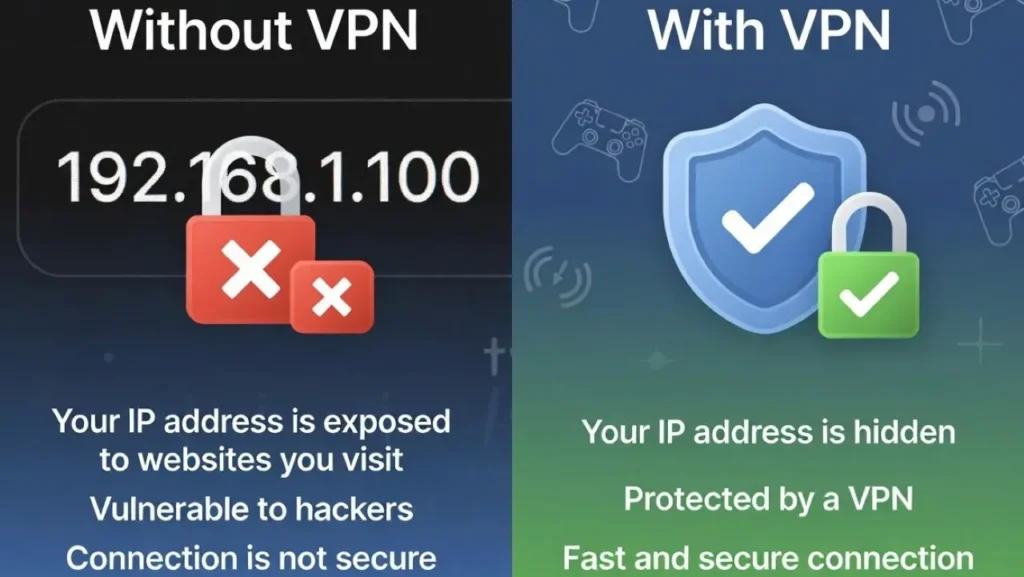
When this happens, your real IP address is hidden and replaced by the IP address of the VPN server.
But the most important part is not just the IP change. A VPN also encrypts your internet traffic. This means your data is protected while it travels across networks, especially on public Wi-Fi or shared connections.
From a user perspective, a VPN works quietly in the background. Once it is turned on, it protects all internet traffic on the device, including browsers, apps, and games.
That is why VPNs are often used for privacy, security, and safer online access.
What Is a Proxy?
A proxy server acts as an intermediary between your device and the internet, but in a simpler way.
When you use a proxy, your request goes through the proxy server before reaching the destination. The server forwards your request and sends the response back to you.
Like a VPN, a proxy can hide your real IP address by replacing it with another one.
However, most proxies do not encrypt your traffic. They mainly change how your request is routed, not how it is protected.
Another key difference is that proxies usually work at the application level. This means they may only affect a specific browser or app, rather than your entire device.
Because of this, proxies are often used for quick tasks such as accessing restricted content, testing locations, or managing simple connections.
They are lighter than VPNs, but also less protective.
Key Differences Between VPN and Proxy
The difference between VPN vs proxy comes down to three main areas: protection, coverage, and reliability.
A VPN encrypts your traffic. A proxy usually does not. This alone changes the level of privacy you get.
A VPN covers your entire device. A proxy often works on a single app or connection.
A VPN is designed for stability and security. A proxy is usually designed for speed and simplicity.
This means that even though both tools can hide your IP address, they do not offer the same level of safety.
If your goal is only to change your visible location quickly, a proxy may be enough. If your goal is to protect your data and connection, a VPN is usually the better option.
VPN vs Proxy for Privacy
Privacy is where the difference becomes very clear.
A VPN protects your data through encryption. This means your internet provider, network administrators, or anyone monitoring the connection cannot easily read your traffic.
A proxy does not provide that level of protection. Your data can still be visible as it travels through the network.
For users who care about privacy, this distinction matters.
A VPN helps protect your browsing activity, login information, and general data flow. A proxy mainly hides your IP address without securing the content of your connection.
In simple terms, a VPN protects both your identity and your data. A proxy mainly hides your identity.
VPN vs Proxy for Gaming
For gaming, the choice depends on what you want to achieve.
A VPN can help hide your real IP address, which may reduce exposure in certain situations. It can also provide a more stable routing path in some cases, depending on the server and network conditions.
However, a VPN may slightly increase latency because your traffic passes through an extra server.
A proxy is lighter and may feel faster in some situations, but it does not protect your connection in the same way. It also does not provide consistent stability across different games and platforms.
For casual use, a proxy might work for simple tasks. For players who want more control over privacy and connection safety, a VPN is generally more reliable.
Speed and Performance Comparison
Speed is one of the most common concerns when comparing VPN vs proxy.
A proxy is usually faster because it does not encrypt data. Less processing means quicker transmission in simple tasks.
A VPN may introduce a small delay because of encryption and routing. However, modern VPNs are optimized to reduce this impact as much as possible.
Performance depends on several factors:
- server location
- network quality
- device performance
- provider infrastructure
In real use, a well-configured VPN can feel smooth and stable. A poor proxy or overloaded server can feel slow despite having no encryption.
So while proxies can be faster in theory, real-world performance depends on quality and setup.
Security Comparison
Security is where VPNs clearly stand out.
A VPN encrypts your data, protects your connection, and often includes additional features such as kill switches or leak protection.
A proxy does not provide these protections in most cases.
If you use a proxy on an unsecured network, your data may still be exposed to risks. This is especially important when using public Wi-Fi or shared networks.
For users who want a secure connection, a VPN is the safer option.
When Should You Use a VPN?
A VPN is a better choice when you want full protection and consistent performance.
You may choose a VPN if you:
- want to protect your online privacy
- use public Wi-Fi networks
- play online games and want to hide your IP
- access sensitive accounts
- prefer an all-in-one solution
A VPN is designed for long-term use, not just quick changes.
When Should You Use a Proxy?
A proxy can be useful for simple and specific tasks.
You may choose a proxy if you:
- need a quick IP change
- test a website from another location
- use a lightweight connection for non-sensitive tasks
- manage multiple connections in a controlled setup
A proxy is more of a tool for convenience than protection.
Final Comparison: Which One Is Better?
There is no single answer that fits every situation, but the difference is clear.
A VPN is better for privacy, security, and overall reliability.
A proxy is better for quick, simple tasks where full protection is not necessary.
If you are unsure, it is usually safer to choose a VPN. It offers more consistent results and protects your data as well as your identity.
A proxy can still be useful, but it should not be treated as a full replacement for a VPN.
FAQ
Is a VPN better than a proxy?
In most cases, yes. A VPN provides encryption and full-device protection, while a proxy usually only changes your IP address.
Can a proxy replace a VPN?
Not completely. A proxy can handle simple tasks, but it does not offer the same level of security or privacy.
Does a VPN slow down gaming?
It can slightly increase latency, but a good VPN setup keeps performance stable.
Is a proxy safe to use?
A proxy can be safe for basic tasks, but it does not protect your data like a VPN does.
Conclusion
The difference between VPN vs proxy becomes clear once you look beyond the surface.
Both tools can change your IP address, but they serve different purposes. A VPN focuses on protection, stability, and privacy. A proxy focuses on simplicity and speed.
Choosing the right option depends on what you need. If your priority is security and consistent protection, a VPN is the better choice. If you only need a quick connection change for a simple task, a proxy may be enough.
Understanding this difference helps you make better decisions online. It also prevents you from relying on a tool that does not fully match your needs.
In the end, the goal is not just to connect to the internet, but to do it in a way that fits your level of privacy and control.